Every year there is a list of “top app trends” full of AR, VR and the metaverse. Very few Indian businesses need any of that. What they need is an app that opens fast on an ordinary phone, lets a customer pay in two taps and talks to them in a language they are comfortable with.
These are the trends we see that genuinely matter if you are planning an app for the Indian market.
1. Designing for the phone people actually own
A large share of your users will be on a mid-range Android phone with limited storage and an uneven mobile connection. That changes what a good app looks like. Keep the download size small, avoid heavy animations on the first screen, cache what you can, and make sure the app still works when the network drops for a minute.
2. UPI and wallets built in
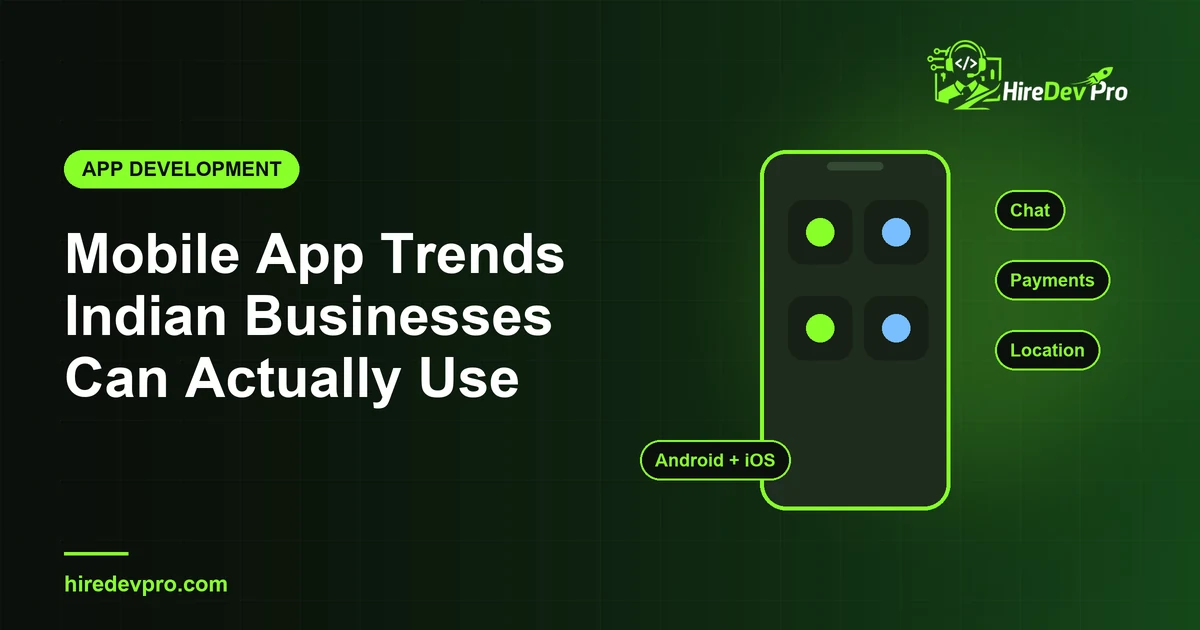
Customers expect to pay with UPI, and they expect it to just work. Integrating a gateway such as Razorpay, PhonePe or Paytm properly, with clear handling of failed and pending payments, removes one of the biggest reasons people abandon a purchase.
3. WhatsApp as part of the experience
Many people would rather message a business than call or fill in a form. Order updates, appointment reminders and support over WhatsApp, connected to your app or backend, often get more attention than a push notification.
4. Local languages
An app in English only quietly excludes a lot of potential customers. Supporting Hindi and one or two regional languages, with the right fonts and a simple language switch, usually does more for growth than any new feature. Plan for it from the start, because adding it late is much harder.
5. AI that saves time
AI is useful in an app when it removes effort: smarter search that understands a misspelt word, suggested replies for support, or a quick summary of a long document. It is less useful as a label stuck on a feature. Ask what it saves the user, and if there is no clear answer, skip it.
6. One codebase for Android and iOS
Cross-platform tools such as Flutter and React Native let one team build for both platforms, which suits most business apps and keeps cost and maintenance down. Native development still makes sense for very demanding apps. We compare the two in our guide on Flutter vs React Native.
7. Privacy and security by default
With India's Digital Personal Data Protection Act, collecting less data and being clear about why is both safer and easier to defend. Ask for permissions only when you need them, store sensitive data carefully and keep the app and its libraries updated.
How to choose your first version
Write down the one thing a customer should be able to do in your app within the first minute: book, order, pay or track. Build that, and build it well. Leave the profile settings, loyalty points and the long wish list for version two. A focused first release is faster to build, easier to test and tells you very quickly what your customers really care about.
What to skip, for now
AR and VR, voice assistants and wearable apps can be impressive, but unless they solve a clear problem for your customers, they add cost without adding sales. Start with the basics above, launch a focused first version and learn from real users.
Planning an app?
Tell us who your customers are and what the app should help them do. We will suggest a sensible first version, the technology to use and a fixed-price proposal within 24 hours of the first call. You can read how we work on our mobile app development page, or send us a message.